upper-limb exoskeleton

An EMG-activated elbow brace for pure motor monoparesis

A muscle-signal-driven elbow exoskeleton that reads bicep EMG activity and drives a servo-actuated brace, built and verified on two test users.

The condition

Pure motor monoparesis (PMM) is an isolated motor deficit, most often following a stroke, that affects a single limb while leaving sensation and other limbs largely unaffected. It's a relatively uncommon presentation — roughly 2.6% of stroke cases — but for the limb it affects, it can mean losing functional strength while retaining full sensation and awareness of the impairment. Most existing upper-body exoskeletons on the patent record are built for rehabilitation programs rather than everyday assistance, leaving a gap for a device meant for daily use.

Design controls

Requirements were built out using a standard design-controls framework, translating each user need into a measurable design output.

User need Design input Design output
Normal elbow range of motion −5° to 146° extension/flexion Goniometer measurement of elbow joint
Comfort Worn up to 3x/week without complaint of pain or discomfort User comfort survey and compliance statistics
Accurately read EMG signal Correctly identify signal corresponding to intent to flex elbow 10 reps intending to lift, 10 reps not intending to lift
Secure attachment to elbow <1mm shift in securement position per flexion/extension cycle Measure securement position before and after a full ROM cycle

The solution

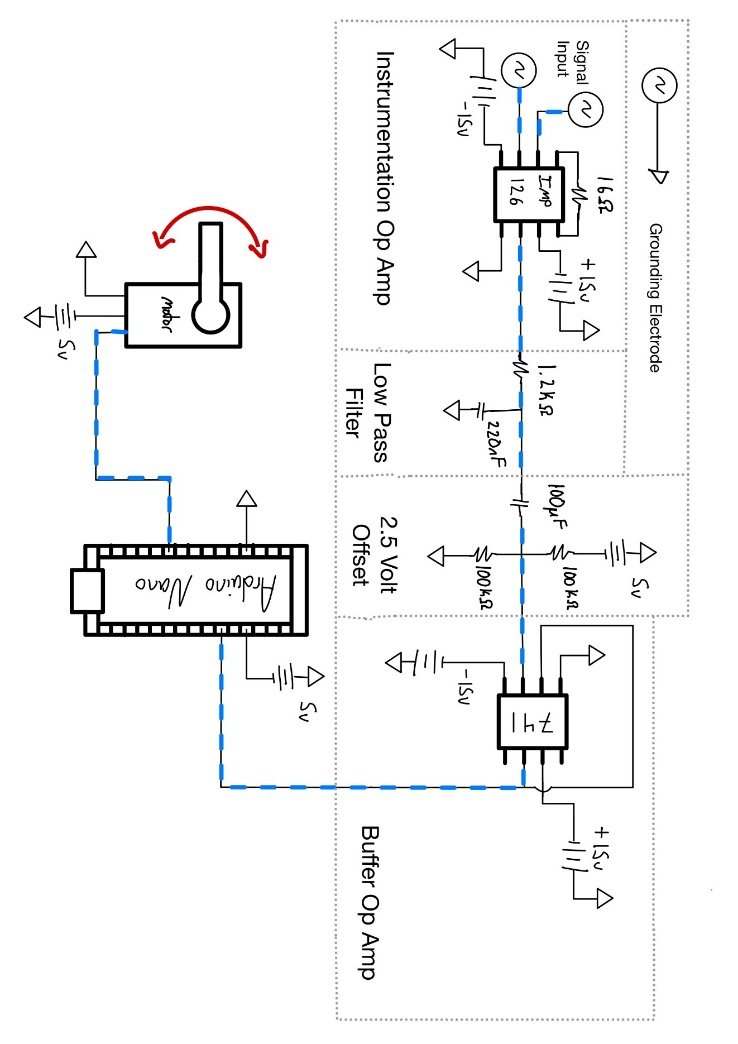
The brace secures aluminum bars to the arm with Velcro, hinged at the elbow joint, with a gear-and-pulley system connecting that hinge to a motor mounted on a harness. EMG electrodes on the bicep feed into an instrumentation amplifier and low-pass filter, buffered through an Arduino Nano, which drives the motor whenever it detects a signal consistent with an intent to flex the elbow.
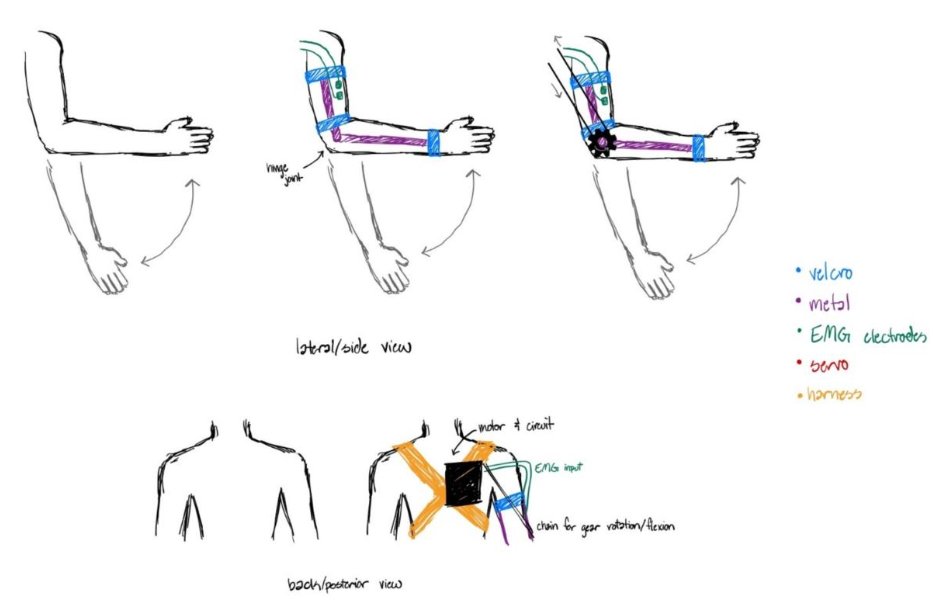
Hand-drawn concept sketches of the elbow brace, showing lateral and posterior views with velcro, metal, EMG electrode, servo, and harness components labeled.
Concept sketches — lateral and posterior views of the brace, servo, and harness
Circuit diagram showing the instrumentation op amp, low pass filter, 2.5 volt offset stage, buffer op amp, and Arduino Nano driving the motor.
EMG signal chain: instrumentation amp → low-pass filter → buffer → Arduino Nano → motor

Verification

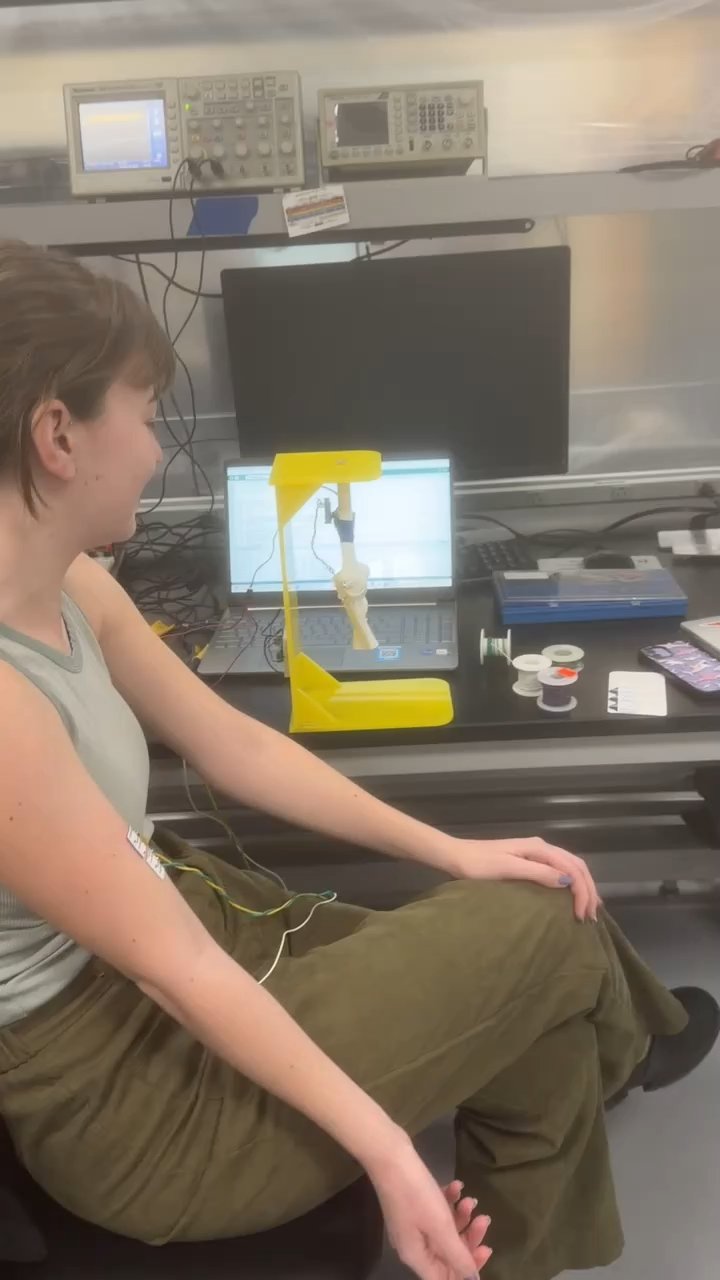
The device was tested on two users, with the servo successfully activating on bicep flexion and returning to rest position when the muscle relaxed. The securement and signal-reading setup adjusted easily between the two testers without any hardware changes, a good early sign for fitting a wider range of users.

A test user wearing the EMG-activated elbow brace prototype in the lab, with electrodes visible on the forearm.
Bench testing the prototype with EMG electrodes attached

key words

exoskeleton design EMG signal processing design controls design verification & testing Arduino servo actuation assistive technology circuit design rehabilitation engineering

Full slide deck

Complete presentation: design controls, circuit schematic, and verification results.

Download PDF