biomaterials & implant design

Redesigning cerclage wire fixation to resist micromotion

A theoretical redesign of a titanium cerclage band, adding a Sharklet-inspired surface microtexture to fight the loosening and slippage that plague conventional cerclage fixation.

Background & problem

There is a need for a cerclage fixation device that securely fixes fracture sites without damaging the periosteum, resisting the micromotion and loosening that plague current designs.

Cerclage wiring is one of the oldest internal fixation techniques on record, tracing back to 1775 when French surgeons first used brass wire to suture bone fragments. It's still a mainstay today, particularly for periprosthetic fractures and cases where conventional screw fixation isn't feasible — but cerclage cables carry a well-documented high failure rate. Loosening and gradual loss of tension let the wire slip and micromotion set in, which can misalign the fracture, damage the periosteal blood supply, and send a patient back to the operating room.

periprosthetic fracture rate after THA

up to 18%

intraoperative fracture, revision arthroplasty

17.6%
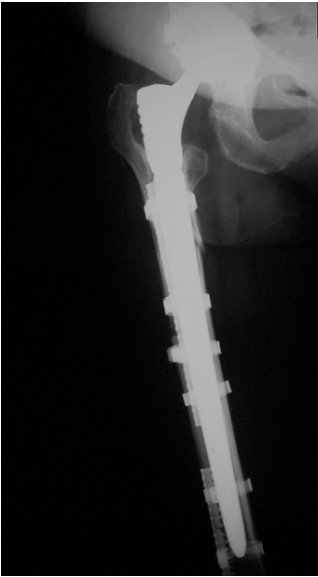
Radiograph of the ImplanTec Compression Cerclage and Stabilisation System fixing an isolated femur fracture.
The ImplanTec® CCG system fixing an isolated femur fracture (ImplanTec, n.d.)

Existing solutions

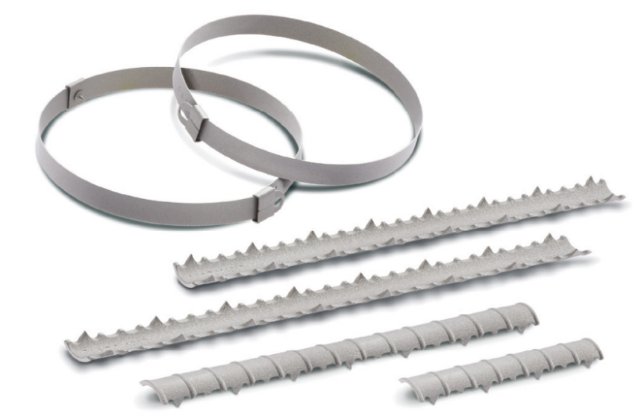
Traditional cerclage wire — solid or multi-stranded, closed by a crimp, twist, or knot — relies entirely on tension to stay put, and that tension is exactly what degrades over time. A newer band-based system increases contact area and control, but neither fully solves the underlying loosening problem.

Standard 1mm cerclage wire — tension-dependent, prone to loosening~$66 ea.
ImplanTec® CCG band system — titanium, adjustable fastener, fixation spikes~$142 ea.
The ImplanTec CCG bands and stabiliser, showing the flat titanium band and spiked stabiliser strips.
The ImplanTec® CCG bands and stabiliser components (ImplanTec, n.d.)

Redesign concept

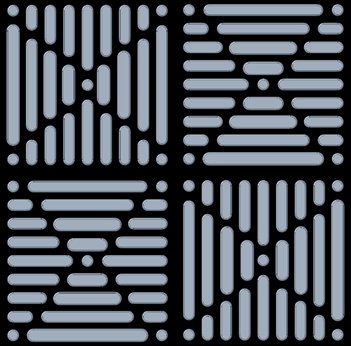
Our redesign keeps the CCG's wider titanium band but adds a Sharklet®-inspired microtexture across its interfacing surface — a pattern normally used to resist bacterial colonization, applied here at a larger scale to increase friction instead. The pattern rotates 90° between quadrants so it resists slipping in every direction, while regularly spaced channels between the textured sections preserve periosteal blood flow that a smooth, fully circumferential band would cut off.

Withstand ≥280N tensile load, minimal micromotion under cyclic loading
Increase bone-implant friction without excess circumferential pressure
Preserve periosteal blood flow via longitudinal channels
Ti-6Al-4V for biocompatibility and corrosion compatibility with implants
Fully removable during revision surgery, standard instrumentation
Radiographically identifiable, minimal surgical workflow changes
Expanded view of the surface microtexture pattern, rotated 90 degrees between quadrants, shown on a black background.
The four-quadrant microtexture pattern — rotated 90° between quadrants to resist slipping in every direction

Analysis

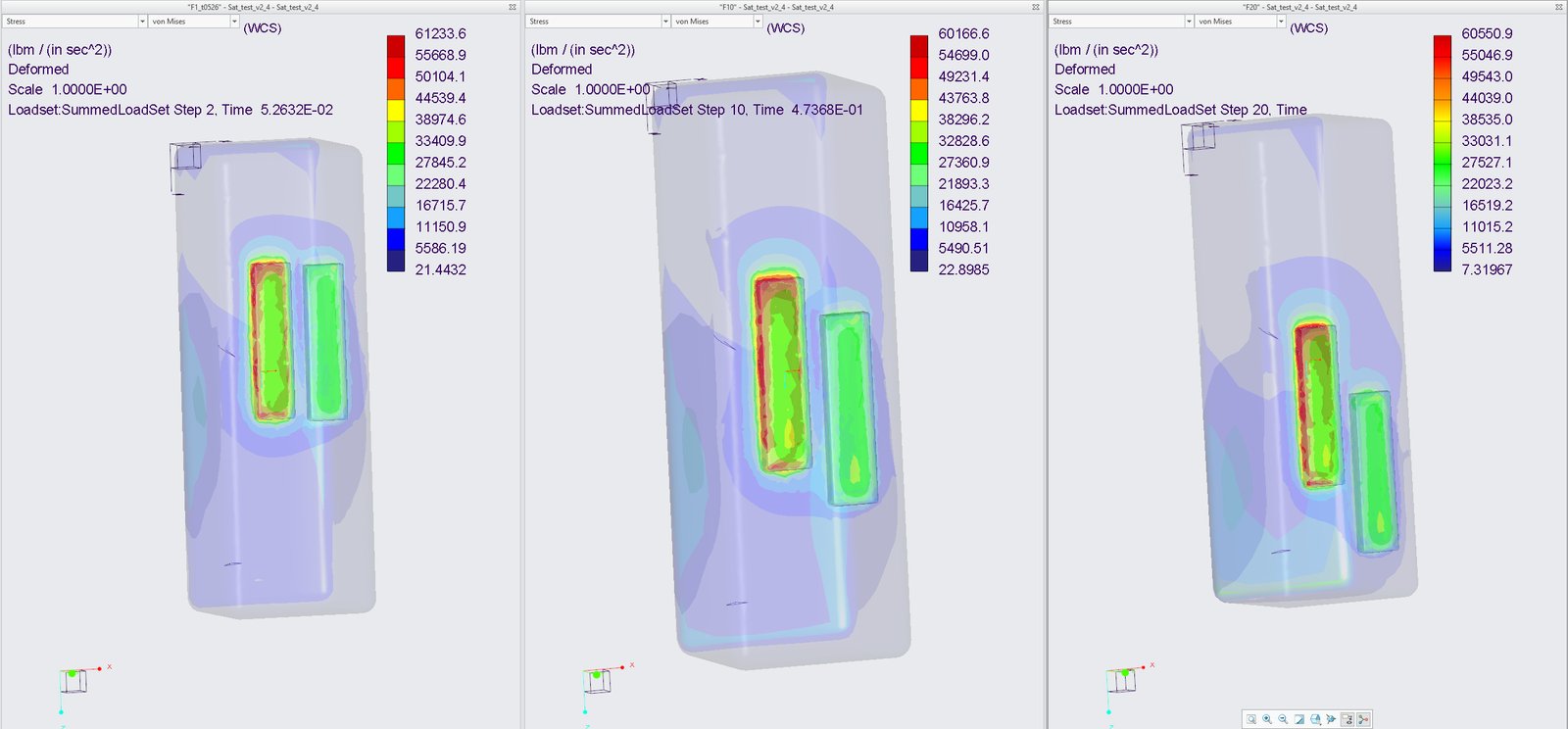
Literature on bone-titanium friction gave us a coefficient of friction (COF) of 0.42 for polished titanium against bone at 0.5 MPa, versus 0.87 for a textured surface at the same pressure — more than double. We built a Creo Simulate model of two titanium bands (polished vs. textured) pressed against a fixed bone block, applied a 100N lateral force to simulate slippage, and compared the resulting Von Mises stress and displacement.

textured COF @ 0.5MPa

0.87

polished COF @ 0.5MPa

0.42

max tensile load target

280 N

band vs. wire pressure

−80%

Three frames of Creo Simulate results showing Von Mises stress distribution as the microtextured plate (left) and polished plate (right) slide across a bone surface.
Von Mises stress at three simulation frames — the microtextured plate (left) consistently shows less displacement than the polished plate (right)

Because the 5mm band spreads clamping force over roughly five times the contact area of a 1mm wire, it drops interface pressure by about 80% relative to wire — from 2.42 MPa down to 0.54 MPa — while the microtexture more than doubles the available friction to compensate. Together, that's the core mechanical argument for the redesign: less crushing pressure on the bone, more resistance to slipping.

Regulatory & testing

As a bone fixation cerclage device, this design falls under FDA product code 4530, a Class II device regulated under 21 CFR 888.3010 and eligible for the 510(k) pathway. That pathway points to a clear set of ASTM standards for material and mechanical testing.

21 CFR 888.3010 — bone fixation cerclage ASTM F2180 — implantable strands & cables ASTM F136 — wrought Ti-6Al-4V for implants ASTM F86 — surface prep & marking ASTM E8/E8M — tension testing ASTM E290 — bend / ductility testing

key words

biomaterials literature review market & prior art research implant design fracture fixation Ti-6Al-4V Creo Simulate FEA tribology Sharklet-inspired microtexture FDA 510(k) ASTM standards orthopedic devices

Full report

Complete write-up with literature review, full simulation setup, material tables, and references.

Download PDF